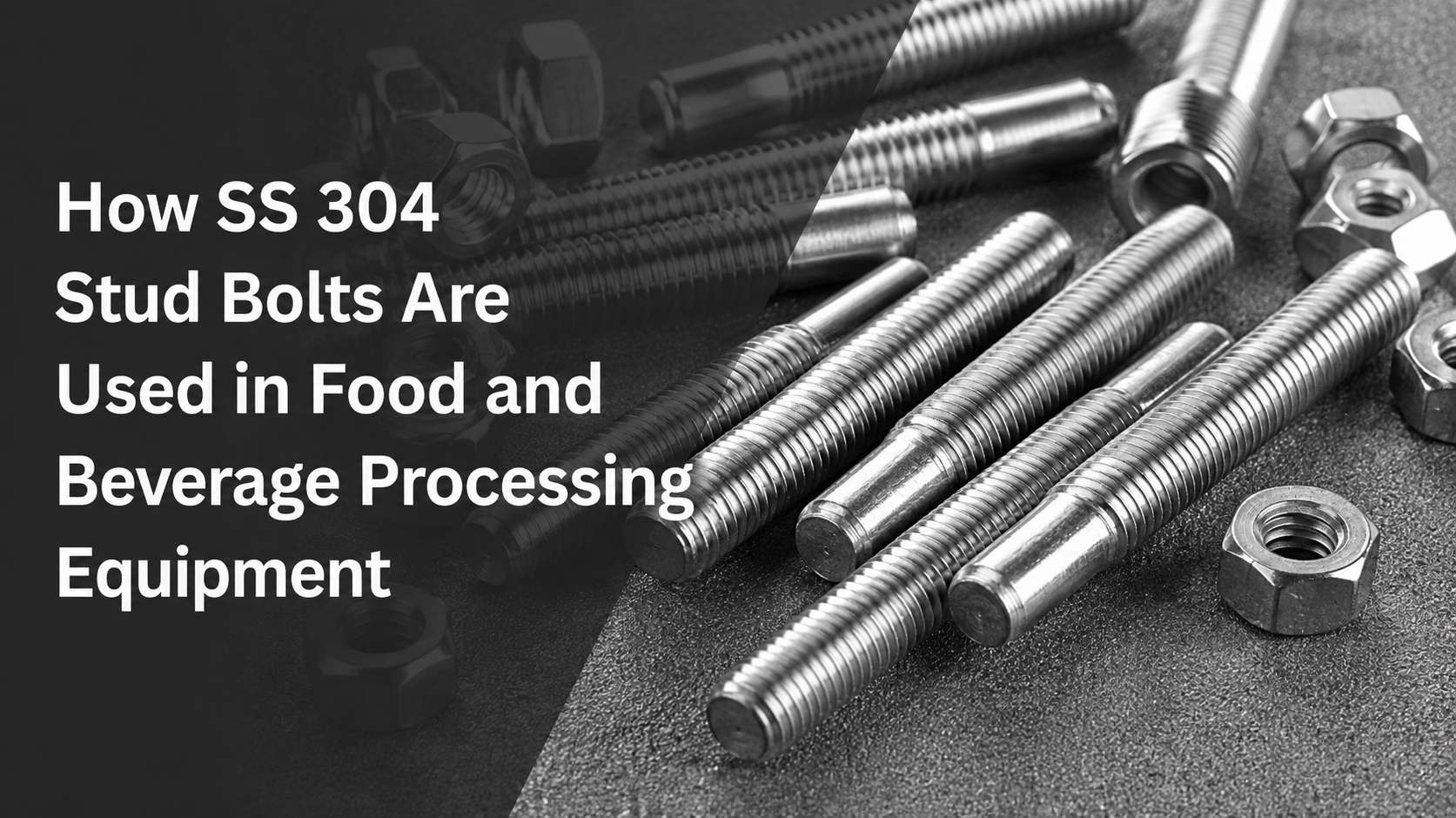
The fasteners in food processing equipment have to keep the assemblies tightly together under continuous washdown and regular vibration. SS 304 stud bolts are a multi-purpose fastener, a threaded rod that is used with two nuts to secure structural and mechanical parts in place in processing plants. Grade 304 is an austenitic 18% chromium and 8% nickel. Factors to consider in the selection of the appropriate fastener include equipment design, chemical cleaning procedures, and operating pressures.
Why SS 304 Stud Bolts Are Considered for Food and Beverage Equipment
Standard equipment framing, mounting plates, and non-contact covers require reliable hardware that will not scale or rust during daily cleaning cycles. Stainless Steel 304 Stud Bolts handle common moisture, steam and mild organic acids found in processing areas. The alloy gives adequate tensile strength for standard pressure flanges, brackets and motor mounts without cracking under regular torque. Maintenance teams can remove and replace them easily during overhauls. Procuring these fasteners in standard metric or imperial threads is straightforward for plant engineers. Using industrial SS 304 Stud Bolts provides practical mechanical stability, though it does not, on its own, certify an entire machine assembly for direct product contact.
Common Food and Beverage Processing Equipment Using Stud Bolts
Stud bolts appear in multiple processing systems, mainly where assemblies require uniform clamping pressure across gaskets or heavy base frames.
Mixing and Blending Equipment
Drive housings, bearing blocks and vessel access covers use these threaded studs to hold steady against rotational forces. They secure bolted structural frames and motor mounts. Threaded connections stay tight during continuous mechanical agitation of dry ingredients and liquids.
Storage and Process Tanks
Holding silos, mixing vats and balance tanks require perimeter fasteners on manway covers, top inspection hatches and liquid level sight glass assemblies. Bolted joints keep seals compressed under hydrostatic liquid loads during daily liquid storage cycles.
Heat Exchangers
Plate frames and shell-and-tube utility heads often utilise high-strength fastening rods. Operating conditions involve alternating temperature runs and clean-in-place solutions. Engineers evaluate the exact wash chemistry to determine whether a 304 alloy matches the thermal stress.
Conveyor Systems
Product transport tracks, roller beds, drip trays and belt guards use these studs for mechanical mounting. Floor-level washdowns expose the lower fasteners to pooling water. The hardware keeps frames rigid as belts move goods between packaging stations.
Benefits of SS 304 Stud Bolts in Processing Environments
The performance of fasteners is a function of their mechanical properties and alloy limits, operating temperatures and containing loads on the production floor.
- Grade 304 alloy resists general corrosion caused by regular exposure to water, steam and neutral process liquids in utility zones.
- Stud assemblies handle repetitive cleaning cycles without flaking rust or shedding loose oxide particles into surrounding dry packaging or processing machinery.
- Continuous threading distributes bolt torque regularly across flanges, which creates uniform clamping on equipment gaskets and structural interface joints.
- Mechanical yield strength is used for most common pressure vessels, external utility piping connections, structural motor brackets and equipment support skids.
- Fastener surfaces with standard smooth machining are rinsed clean during routine sanitation cycles whenever the equipment layout prevents blind liquid pooling.
- Global dimensional standardisation makes replacement components readily accessible through regular industrial supply channels for scheduled maintenance shutdowns.
- Threaded studs allow dual-nut tensioning from either side, simplifying replacement work inside tight equipment layouts where through-bolts cannot easily fit.
How to Choose the Right SS 304 Stud Bolts
SS 304 stud bolts provide reliable, corrosion-resistant fastening for food and beverage equipment frames, covers, and utility lines, with performance depending on operating environments and proper material specification.
Sizing and Thread Type: Choose the correct diameter and length for full thread engagement. Use continuous-thread studs for pipe flanges and double-end studs for tapped machine castings.
Nut Compatibility: Pair studs with matching nuts, applying anti-seize lubricants or varying hardness levels to prevent thread galling during tightening.
Mechanical Ratings: Verify that the tensile strength, proof load, and yield limits handle the equipment’s operating pressures and structural loads.
Corrosive Exposure: SS 304 handles basic dairy, dry goods, and utility water, but high-chloride or hot-brine environments require upgrading to grade 316.
Surface Finish: Specify smooth, burr-free finishes to shed washdown fluids easily and eliminate crevices where bacteria or debris can collect.
Certification and Sourcing: Verify Mill Test Certificates (MTCs) to confirm alloy chemistry and source from established manufacturers for consistent dimensional tolerances.
Conclusion
Using the correct fasteners helps keep food and beverage lines running by minimising unscheduled downtime from broken or rusted fasteners. Grade 304 studs offer a balance of strength and corrosion resistance for typical processing applications. With the selection of specific fastener sizes, plant engineers need to consider process fluids, cleaning agents and load before making a decision.