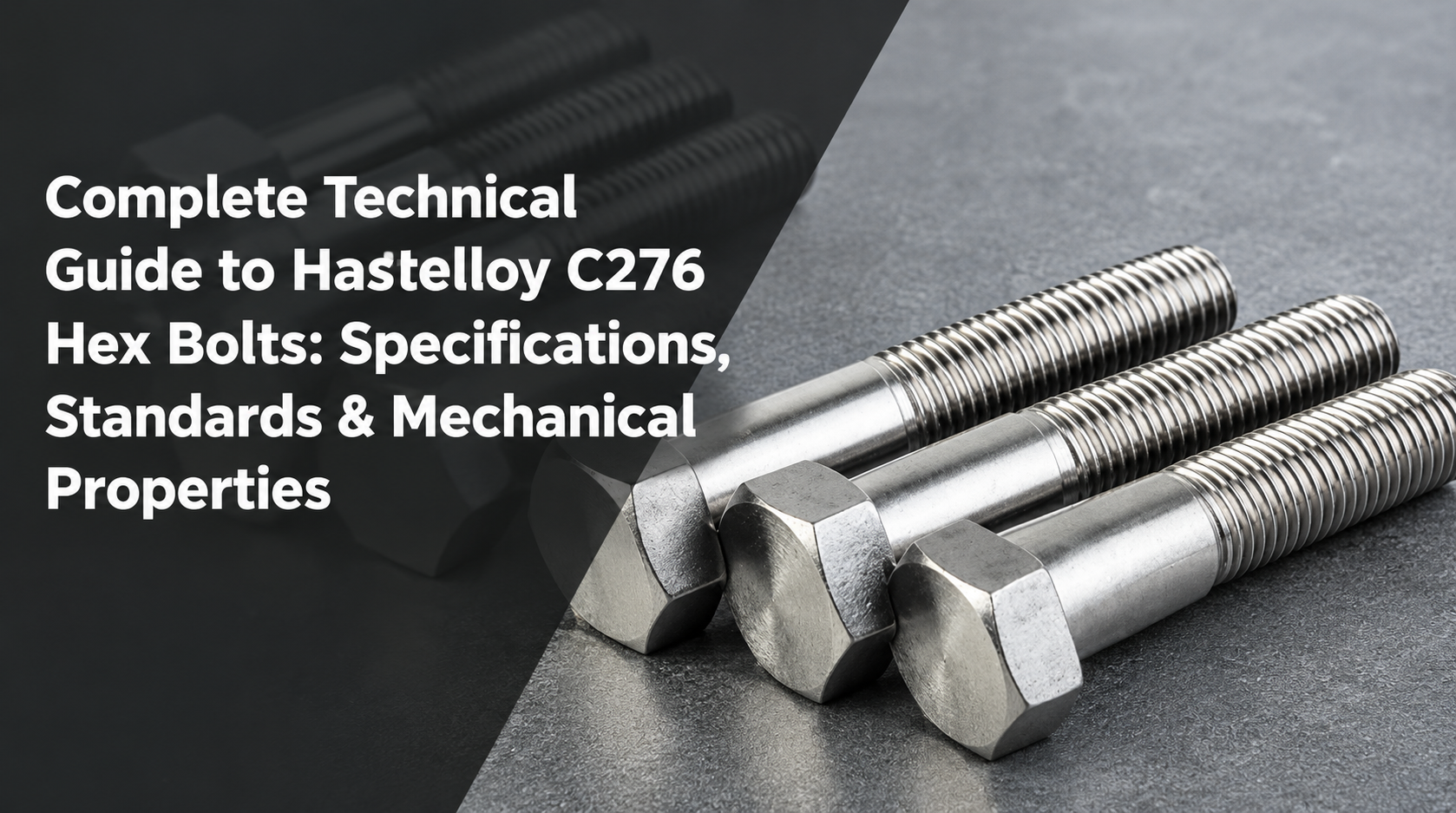
A corrosive process line usually fails at the joint before it fails at the pipe wall. It influences fastener selection in chemical plants and offshore facilities and explains how Hastelloy C276 hex bolts appear so often on bills of materials for equipment handling wet chlorine, sulphuric acid, or seawater. A bolt cut from a low quality alloy can undermine a perfectly specified vessel or flange. Choosing the right fastener includes checking the material specification, the governing dimensional standard, and the mechanical properties the bolt must deliver together. This guide covers each of those, as well as where these bolts are used and how they should be installed and maintained.
Understanding Hastelloy C276 Hex Bolts
Hastelloy C276 is a nickel-molybdenum-chromium alloy, registered as UNS N10276, developed to resist oxidizing and reducing chemical attack within a single material. Hex bolts machined from this alloy carry that same corrosion resistance into the mechanical joint, where a weaker fastener would otherwise become the failure point. The hexagonal head allows torque to be applied with standard wrenches and sockets, which matters on congested skids where space for speciality tooling runs short. Chemical processing lines, flue gas desulphurisation units, and offshore piping systems rely on this pairing of chemistry and geometry. Pulp and paper mills and refineries specify the same bolts wherever a joint has continuous contact with acidic or chloride-bearing media.
Key Specifications of Hastelloy C276 Hex Bolts
Procurement teams check material specification before anything else on a Hastelloy C276 hex bolt order, since it determines what the fastener is permitted to do within a given system. ASTM B574 and ASME SB574 control the nickel alloy bars and rods used to machine these bolts, and confirming compliance protects against alloy substitution further down the supply chain. Thread standards follow either metric pitch or the UNC/UNF imperial series, depending on the mating flange or the equipment’s country of origin. Metric and imperial sizing exist side by side for a simple reason: plants built to European codes and plants built to American codes both specify this alloy.
| Parameter | Typical Standard |
| Material Grade | Hastelloy C276 (UNS N10276) |
| Material Specification | ASTM B574 / ASME SB574 |
| Thread Standards | Metric / UNC / UNF |
| Head Type | Hex Head |
| Applications | Industrial fastening |
Mechanical Properties That Matter
Five mechanical properties decide whether a Hastelloy C276 hex bolt survives its service life: tensile strength, yield strength, toughness, ductility, and fatigue resistance. High tensile strength lets the bolt carry heavy preload without stretching, keeping a joint sealed under process pressure. Good yield strength resists permanent deformation, so the fastener holds its clamping force through thermal cycling. Toughness matters most during installation, where impact from wrench slip or a misaligned flange can crack a brittle fastener before it sees service. Ductility lowers the risk of sudden, brittle-style cracking, and fatigue resistance keeps the bolt stable through vibration and pressure cycling typical of rotating equipment.
| Mechanical Property | Importance |
| High Tensile Strength | Handles high preload applications |
| Good Yield Strength | Resists permanent deformation |
| High Toughness | Reliable under impact loading |
| Ductility | Reduces cracking risk |
| Fatigue Resistance | Suitable for cyclic loading |
Industry Standards Governing Hastelloy C276 Hex Bolts
International standards exist so a bolt ordered in one country performs identically to a bolt ordered in another. ASTM sets the chemical composition and mechanical property limits an alloy must meet before it can be called Hastelloy C276 at all. ASME specifications extend those requirements into pressure-retaining, safety-critical applications, fixing how the material gets tested and certified. DIN and ISO dimensional standards set thread geometry, head dimensions, and tolerances, keeping bolts from different manufacturers interchangeable. Compliance with the applicable standard isn’t optional paperwork. It’s the documented proof an inspector or client asks for before a joint gets approved for service.
Why Hastelloy C276 Hex Bolts Perform in Corrosive Environments
Molybdenum content gives the alloy its resistance to reducing acids such as hydrochloric and sulphuric acid, alongside oxidizing species that would pit a lower-alloyed fastener within a single service cycle. Chloride resistance sets it apart from standard stainless steel bolts. Seawater and chlorinated process streams attack stainless fasteners at the surface first; chromium and molybdenum work together to stabilise the passive oxide layer on Hastelloy C276 against that attack. Pitting and crevice corrosion, the two failure modes most common under bolt heads, progress much slower in this alloy. Stress corrosion cracking resistance is also important, allowing bolts to remain under tensile load in chloride-rich environments without the delayed cracking that ends the service life of less resistant grades.
Industrial Applications of Hastelloy C276 Hex Bolts
Chemical processing, oil and gas, marine and offshore, pollution control, power generation, and pharmaceutical manufacturing account for most of the demand for hex bolts in this alloy.
Chemical Processing Plants
Reactor flanges, connections for acid storage tanks, and heat exchanger joints exposed to mixed acid streams all call for this alloy. Wet chlorine service, in particular, rules out standard stainless steel fasteners outright.
Oil & Gas Facilities
Sour gas service exposes fasteners to hydrogen sulphide and chlorides at once. Hastelloy C276 resists both without the sulphide stress cracking that limits other corrosion-resistant grades.
Marine & Offshore Equipment
Chloride resistance decides the outcome here. Continuous seawater exposure and salt spray would pit a stainless bolt within a few seasons; these bolts hold subsea and topside equipment together well beyond that timeframe.
Pollution Control Systems
Scrubber systems and flue gas desulphurisation units combine acidic condensate with high chloride concentrations, a mix that attacks standard stainless fasteners from two directions at once. Hastelloy C276 hex bolts hold up under that dual attack.
Power Generation Plants
Scrubber ductwork, cooling water systems, and flue gas paths expose fasteners to condensing acidic vapour. Long maintenance intervals matter here, since shutdown access makes frequent bolt replacement expensive.
Pharmaceutical & Process Industries
Batch reactors and clean-in-place systems rotate fasteners through acids, caustics, and sanitising agents within a single process cycle. One alloy that resists all three simplifies procurement and maintenance planning alike.
Key Considerations When Selecting Hastelloy C276 Hex Bolts
Operating environment and the specific corrosive media present come first when selecting this alloy, since chloride concentration and acid type determine whether a lower grade would suffice. Temperature conditions affect both corrosion rate and property retention. Load requirements set the minimum tensile and yield strength the joint demands, while compatibility with mating materials prevents galvanic corrosion even when the bolt itself resists attack. Applicable standards close the list: the specification on the drawing or purchase order fixes which certification the bolt has to carry.
Common Installation and Maintenance Practices
Correct tightening sequence matters as much as bolt selection itself. Cross-pattern tightening, applied in stages, prevents uneven flange loading that no fastener grade can compensate for. Proper torque, set according to bolt diameter and the gasket being compressed, avoids under-tightening leaks and over-tightening that yields the bolt permanently. Nickel alloy fasteners gall easily during installation, so anti-seize compound rated for high-nickel alloys belongs on the threads before assembly. Periodic inspection catches early-stage pitting before it turns into a joint failure, and scheduled maintenance, timed to shutdown windows, keeps bolted connections in known condition.
Conclusion
Hastelloy C276 hex bolts earn their place on chemical, offshore, and power generation projects because they solve a problem standard stainless fasteners can’t: simultaneous resistance to acids, chlorides, and pitting within one bolted connection. Selecting the right one means checking the material specification, the dimensional standard, and the mechanical properties against actual service conditions, not against a generic corrosion-resistant label. Standards compliance protects the buyer as much as the joint, since it’s the only objective proof a bolt will perform as specified. Review the product page for full dimensional ranges, thread options, and certification details before finalising a purchase order.