
Fasteners play a critical role in ensuring the safety, strength, and reliability of mechanical and structural assemblies. Among the most commonly used fasteners in industrial applications are stud bolts and machine bolts. While both are designed to join components securely, their construction, installation method, and applications differ significantly.
At Vision Alloys, we manufacture and supply high-quality stud bolts and machine bolts engineered to meet stringent industrial standards. This guide explains the key differences between stud bolts and machine bolts to help you choose the right fastening solution.
What Is a Stud Bolt?
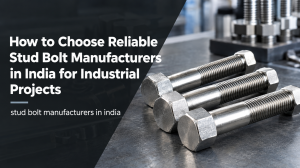
A stud bolt is a threaded fastener with no head and threads on both ends or along its entire length. It is typically used with two nuts—one on each end—or screwed into a tapped hole on one side and secured with a nut on the other.
Stud bolts are widely used in high-pressure and high-temperature environments where strong, uniform clamping force is required.
Key Features of Stud Bolts
- No head, fully or partially threaded
- Uses nuts on both ends
- Provides even load distribution
- Ideal for heavy-duty and critical applications
What Is a Machine Bolt?
A machine bolt is a fastener with a head on one end and threads on the other. It is installed by inserting the bolt through aligned holes and securing it with a nut, or by threading it directly into a tapped hole.
Machine bolts are commonly used in general engineering, construction, and equipment assembly where frequent removal or adjustment may be required.
Key Features of Machine Bolts
- Headed fastener
- Partially threaded shank
- Installed with a nut or tapped hole
- Easy installation and removal
Key Differences Between Stud Bolts and Machine Bolts

Design and Construction
Stud bolts have no head and rely on nuts for tightening, while machine bolts feature a defined head that allows torque to be applied during installation.
Installation Method
Stud bolts are often permanently installed into one component, reducing wear on the base material during repeated assembly. Machine bolts are inserted and removed entirely during installation and maintenance.
Load Distribution
Stud bolts offer superior load distribution, making them suitable for flanged joints and pressure systems. Machine bolts are effective for moderate loads but may not provide the same uniform clamping force.
Application Environment
Stud bolts are preferred in high-pressure, high-temperature, and corrosive environments such as oil & gas and power plants. Machine bolts are commonly used in structural assemblies, machinery, and general industrial equipment.
Maintenance and Reliability
Stud bolts reduce thread wear on the main component and improve joint reliability over time. Machine bolts are easier to replace but may cause thread wear in tapped holes with frequent use.
Applications of Stud Bolts
Stud bolts are widely used in:
- Pipe flanges and pressure vessels
- Heat exchangers and boilers
- Oil & gas and petrochemical plants
- Power generation equipment
Their strength and reliability make them ideal for critical industrial systems.
Applications of Machine Bolts
Machine bolts are commonly used in:
- Structural steel connections
- Industrial machinery assembly
- Automotive and mechanical equipment
- Maintenance and repair applications
Their versatility and ease of use make them suitable for a wide range of projects.
Materials and Standards
Both stud bolts and machine bolts are manufactured in materials such as carbon steel, alloy steel, and stainless steel. Common standards include ASTM, ASME, DIN, and ISO, ensuring strength, dimensional accuracy, and performance consistency.
Vision Alloys supplies fasteners that meet international quality and safety standards.
Choosing Between Stud Bolts and Machine Bolts
The choice between a stud bolt and a machine bolt depends on the application requirements. Stud bolts are ideal for permanent or high-load assemblies, while machine bolts are better suited for general fastening and applications requiring easy disassembly.
Understanding the operating conditions, load requirements, and maintenance needs is key to selecting the right fastener.
Why Choose Vision Alloys?
Vision Alloys is a trusted manufacturer and supplier of industrial fasteners, offering stud bolts and machine bolts engineered for demanding environments. Our products are known for precision, durability, and consistent quality.
We offer:
- Wide range of materials and grades
- Custom manufacturing as per drawings
- Strict quality control and testing
- Reliable supply and competitive pricing
Conclusion
While stud bolts and machine bolts may appear similar, their design, installation, and performance characteristics differ significantly. Stud bolts excel in heavy-duty and high-pressure applications, while machine bolts offer convenience and versatility for general fastening needs. By choosing the right fastener from Vision Alloys, industries can ensure safety, efficiency, and long-term reliability in their operations.