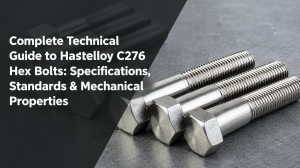

Inconel 718 is a high-strength, corrosion-resistant nickel-chromium alloy that has found widespread use in demanding applications across various industries, including aerospace, power generation, and chemical processing. Its unique chemical composition gives it exceptional resistance to heat, oxidation, and corrosion while maintaining strength and performance even in extreme environments.
At Vision Alloys, we manufacture and supply a wide range of Inconel products tailored to meet the demanding needs of various industries. Our Inconel 718 products include Inconel 718 Stud Bolts, Inconel 718 Fasteners, Inconel 718 hex bolt and Inconel 718 hex nut. We also offer a complete line of other Inconel alloys such as Inconel 600, Inconel 625, and Inconel 800, which are available in various forms such as fasteners, round bars, plates, washers, and flanges. Based in Mumbai, we are recognized as a leading Inconel product manufacturer and supplier in India, committed to providing the highest quality and performance-driven materials for your industrial needs.
This blog provides a detailed guide to the Inconel 718 Chemical Composition, breaking down each element’s contribution to its impressive properties.

Chemical composition of Inconel 718
1. Nickel (50-55%)
Nickel is the primary element in Inconel 718, accounting for approximately 50-55% of its total composition. Nickel enhances the alloy’s overall corrosion resistance, particularly in high-temperature environments, and plays a significant role in resisting oxidation. Nickel’s presence also helps maintain the material’s strength at elevated temperatures, making Inconel 718 an excellent choice for gas turbines, heat exchangers, and jet engines.
2. Chromium (17-21%)
Chromium is another crucial element, making up 17-21% of Inconel 718’s composition. Chromium is primarily responsible for the alloy’s oxidation and corrosion resistance. It forms a protective oxide layer on the surface, which shields the material from further oxidation and corrosion, particularly in high-temperature or acidic environments. This makes Inconel 718 ideal for applications exposed to high heat, such as exhaust systems and combustion chambers.
3. Molybdenum (2.8-3.3%)
Molybdenum, present at 2.8-3.3%, significantly improves the alloy’s strength, particularly in high-stress environments. It enhances the material’s resistance to pitting and crevice corrosion, making Inconel 718 suitable for applications involving harsh chemicals or seawater exposure, such as marine and offshore equipment.
4. Niobium (4.75-5.5%)
Niobium is one of the critical elements in Inconel 718, contributing to its excellent strength. Present at 4.75-5.5%, niobium helps the alloy undergo a unique precipitation hardening process, where microscopic particles form during heat treatment, drastically improving the alloy’s strength. This feature allows Inconel 718 to maintain superior mechanical properties at high temperatures and under significant loads, making it ideal for aerospace components like turbine blades.
5. Iron (Balance)
Iron makes up the balance of Inconel 718’s composition. Though it doesn’t contribute significantly to the alloy’s strength or corrosion resistance, iron serves as a balancing element to improve the overall stability of the alloy without diminishing its other key properties. The presence of iron also makes the alloy slightly more economical to produce compared to other nickel-based superalloys.
6. Titanium (0.65-1.15%)
Titanium, present at 0.65-1.15%, works synergistically with niobium to improve the alloy’s strength during the precipitation hardening process. Titanium also contributes to Inconel 718’s ability to resist stress corrosion cracking and oxidation, which is particularly important in applications that are exposed to high pressures and temperatures.
7. Aluminum (0.2-0.8%)
Though a relatively small component of Inconel 718, aluminum plays a critical role in enhancing the alloy’s oxidation resistance. By contributing to the formation of a stable oxide layer, aluminum helps prevent the degradation of the alloy in high-temperature environments. It also aids in maintaining the alloy’s structural integrity, making it suitable for applications such as nuclear reactors and rocket engines.
8. Cobalt (1% max)
Cobalt is an optional element in Inconel 718, and if present, it can be included up to a maximum of 1%. Cobalt enhances the alloy’s strength and resistance to oxidation at extremely high temperatures, making it valuable for specific high-performance applications, although it’s not always required.
9. Other Elements
Inconel 718 also contains trace amounts of elements like manganese (0.35% max), silicon (0.35% max), sulfur (0.015% max), and copper (0.3% max). These elements are present in small quantities to refine the alloy’s overall properties and to aid in the manufacturing process, but they do not significantly alter the alloy’s performance.
Properties Derived from Inconel 718’s Chemical Composition
The carefully balanced composition of Inconel 718 leads to several key properties that make it ideal for high-stress, high-temperature applications:
- High Tensile Strength and Creep Resistance: Inconel 718’s unique combination of nickel, chromium, niobium, and molybdenum gives it outstanding tensile strength and creep resistance, even in temperatures as high as 700°C (1300°F).
- Exceptional Corrosion Resistance: The high levels of nickel and chromium allow Inconel 718 to resist a wide variety of corrosive environments, including acidic and seawater conditions.
- Oxidation Resistance: Thanks to the combination of chromium and aluminum, Inconel 718 can withstand prolonged exposure to high-temperature oxidative environments without significant degradation.
- Precipitation Hardening: The niobium and titanium content of Inconel 718 allows it to be precipitation-hardened, which increases its strength and makes it capable of withstanding extreme mechanical stress.