Stainless steel fasteners are used in almost every sector that deals with moisture, chemicals, or heat. Among all the grades available, 316 stainless steel bolts have become the preferred choice for applications where corrosion is a real concern. Marine structures, chemical processing lines, pharmaceutical plants, and food equipment setups all depend on fastener material just as much as structural design in these environments.
Standard grades like 304 hold up in mild conditions. Push them into saltwater or chloride-heavy exposure and the surface degrades faster than expected. That is the gap 316 SS bolts address. For anyone sourcing fasteners for demanding conditions, understanding that distinction is the starting point.
What Are 316 SS Bolts?
316 stainless steel bolts are threaded fasteners made from an austenitic alloy containing chromium, nickel, and molybdenum. Molybdenum is what separates 316 from standard stainless grades. It significantly improves resistance to pitting and crevice corrosion in chloride-rich environments.
The alloy typically contains 16-18% chromium, 10-14% nickel, and 2-3% molybdenum. Similarly, the complete SS 316 Bolts specification shows how the product behaves in various environments and how you can have optimum use of it.
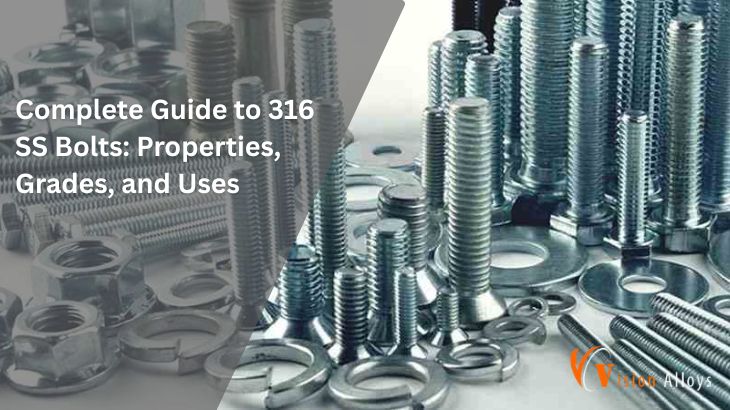
316 SS bolts are supplied in several forms. Hex bolts cover general structural assemblies. Stud bolts are used in flanged piping and pressure vessel connections. Socket head bolts are specified where clearance is limited. For a broader look at how these fastener types work together, see the complete guide on uses of bolts and nuts.
Chemical Composition and Mechanical Properties of 316 SS Bolts
Chemical Composition (316 / 316L)
| Element | 316 (%) | 316L (%) |
| Chromium (Cr) | 16.0 – 18.0 | 16.0 – 18.0 |
| Nickel (Ni) | 10.0 – 14.0 | 10.0 – 14.0 |
| Molybdenum (Mo) | 2.0 – 3.0 | 2.0 – 3.0 |
| Carbon (C) | Max 0.08 | Max 0.03 |
| Manganese (Mn) | Max 2.0 | Max 2.0 |
| Silicon (Si) | Max 0.75 | Max 0.75 |
| Iron (Fe) | Balance | Balance |
Mechanical Properties
| Property | Value |
| Tensile Strength (Min) | 515 MPa |
| Yield Strength (Min) | 205 MPa |
| Elongation (Min) | 40% |
| Hardness (Brinell) | Max 217 HB |
| Heat Resistance | Up to 870°C (intermittent) |
Corrosion resistance is substantially higher than 304 in chloride environments. Pitting resistance is directly linked to molybdenum content.
Grades and Specifications of 316 Stainless Steel Bolts
ASTM A193 Grade B8M covers high-temperature service bolting in 316 stainless steel. It applies to stud bolts, hex bolts, and other externally threaded fasteners for pressure vessels, valves, and flanges.
ASTM F593 covers stainless steel bolts and hex cap screws for general use. Group 2 under this standard covers 316 and 316L.
DIN and ISO standards are commonly referenced for export and European projects. ISO 3506 covers mechanical properties for stainless steel fasteners.
On 316 versus 316L: the difference is carbon content. 316L has a maximum of 0.03% carbon versus 0.08% in standard 316. Lower carbon reduces sensitization risk during welding. For fabricated assemblies with welded joints, SS 316L hex bolts are the correct specification. Where welding is not involved, both grades perform similarly under most service conditions.
Applications and Uses of 316 SS Bolts
Marine industry
Saltwater accelerates corrosion faster than almost any other exposure. Dock structures, offshore platforms, and underwater assemblies demand fasteners that resist chloride attack for a long time.
Chemical processing plants
Flanged connections and valve assemblies in these plants specify 316 or 316L for resistance to dilute acids and chlorine-based compounds.
Oil and gas
316 stainless steel bolts are used in instrument connections, skid assemblies, and above-ground process equipment across oil and gas facilities.
Pharmaceutical and food processing
316L is standard in both sectors. Low carbon content, ease of cleaning, and resistance to caustic washdown chemicals drive that preference.
Water treatment and construction
Chlorinated water systems and coastal construction both rely on 316 SS bolts to reduce corrosion-related maintenance over the structure’s service life.
The uses of bolts and nuts for joining heavy equipment and structural components in all these sectors depend on correct material selection. Choosing the wrong grade to cut cost typically results in faster replacement cycles.
Advantages of 316 Stainless Steel Bolts
- Corrosion resistance in chloride and acidic environments is the primary benefit over other grades
- Long service life with low maintenance requirements
- Heat resistance up to 870°C under intermittent exposure
- Consistent tensile and yield strength across production batches when manufactured to ASTM or ISO standards
- Non-contaminating surface, easy to clean, suitable for food and pharmaceutical contact
How to Choose the Right 316 SS Bolts
Start with the environment. Chloride or saltwater exposure points directly to 316 or 316L. For welded assemblies, 316L is the correct choice because of its lower carbon content.
Load requirements determine bolt size. ASTM A193 B8M tensile and yield values must match the joint design. Undersizing creates failure risk in pressurised or load-bearing connections.
Thread form should match the mating component. For metric applications, ISO standards apply. For inch-series, ASME B18.2.1 and ANSI standards cover dimensions.
Compliance requirements should be confirmed with the supplier before ordering. ASTM, DIN, ISO, and ANSI certifications, along with material test reports, are standard documentation in most industrial procurement processes.
Conclusion
316 stainless steel bolts are specified where corrosion resistance is a real requirement and fastener failure has consequences. The molybdenum content provides performance that 304 stainless does not match in chloride or acidic conditions.
For welded assemblies, 316L is the correct grade. For general structural and mechanical applications in corrosive environments, standard 316 covers most requirements. Selecting SS 316L hex bolts and 316L stainless steel stud bolts from a certified manufacturer with proper material documentation reduces procurement risk and keeps projects compliant.
Vision Alloys supplies 316 and 316L stainless steel bolts in standard and custom configurations to ASTM, DIN, ISO, and ANSI standards. Contact our team for specifications or technical queries.